What CertPath is and what it's for
Certifications and career roadmaps platform.
If you work in technology—or want to get into it—sooner or later you'll run into the same wall: certifications. Everyone says they matter, that they open doors and increase salaries, but no one explains which one to get, in what order, or what each one is for. CertPath was born out of that frustration. It's a platform that turns the chaos of IT certifications into a clear path, guided by the position you really want to reach.
In this article, I'll tell you what CertPath is, what problem it solves, how it works internally, and who it's for. No sugarcoating: it's a real project, in production, that you can try out.
The chaos of certifications in technology
The IT certification ecosystem is huge and, above all, disorganized. Microsoft, AWS, Google Cloud, Cisco, CompTIA, Red Hat, ISACA, (ISC)²… each manufacturer has its own catalog, its own nomenclature, and its own route. There are over a dozen certifications in Azure alone; in AWS, just as many; in networking, the Cisco universe is almost a career in itself. Multiply that by all the disciplines—systems, networking, cloud, cybersecurity, data, development—and you have hundreds of options on the table.
The problem isn't a lack of information; it's too much information without context. When someone starts out, the questions that really matter don't have an easy answer:
- Where do I start if I want to be a systems administrator? And if I want to move into cybersecurity?
- Is a "foundations" certification useful for anything, or is it a waste of time?
- Do I need to get one before I can understand the next one?
- What is a company really looking for when they ask for "certification X" in a job offer?
- Am I investing time and money in something that brings me closer to my goal, or am I just collecting badges?
I've seen many people—and it's happened to me—spend months preparing for a certification that, in the end, didn't fit the path they wanted to follow. Not because it was bad, but because it was out of order or off-target. That's the real trap: it's not hard to study; it's hard to decide what to study.
To that opportunity cost, you have to add the economic one. Many certification exams cost between 150 and 400 euros, and official preparation isn't cheap. Making a mistake in choosing a certification isn't just losing weeks of study; it's throwing away money and, worse, losing motivation. After a couple of setbacks like that, many people give up on the idea of getting certified altogether, when the problem was never their ability, but the lack of a plan.
Why a roadmap and not a list
The usual reaction to this chaos is to make a list: "these are the 20 most in-demand certifications." But a flat list doesn't solve anything because not all certifications are at the same level or make sense at any given time. There are foundation certifications designed for those starting out, others for associates that assume prior experience, and others for experts that only make sense when you've already been in the field for years.
What really helps isn't a list; it's a map: a route that tells you "to get here, first go through here." That's a roadmap. And the difference is huge:
- A list overwhelms you: 20 options, and you're deciding blindly.
- A roadmap guides you: a starting point, a logical order, and a destination.
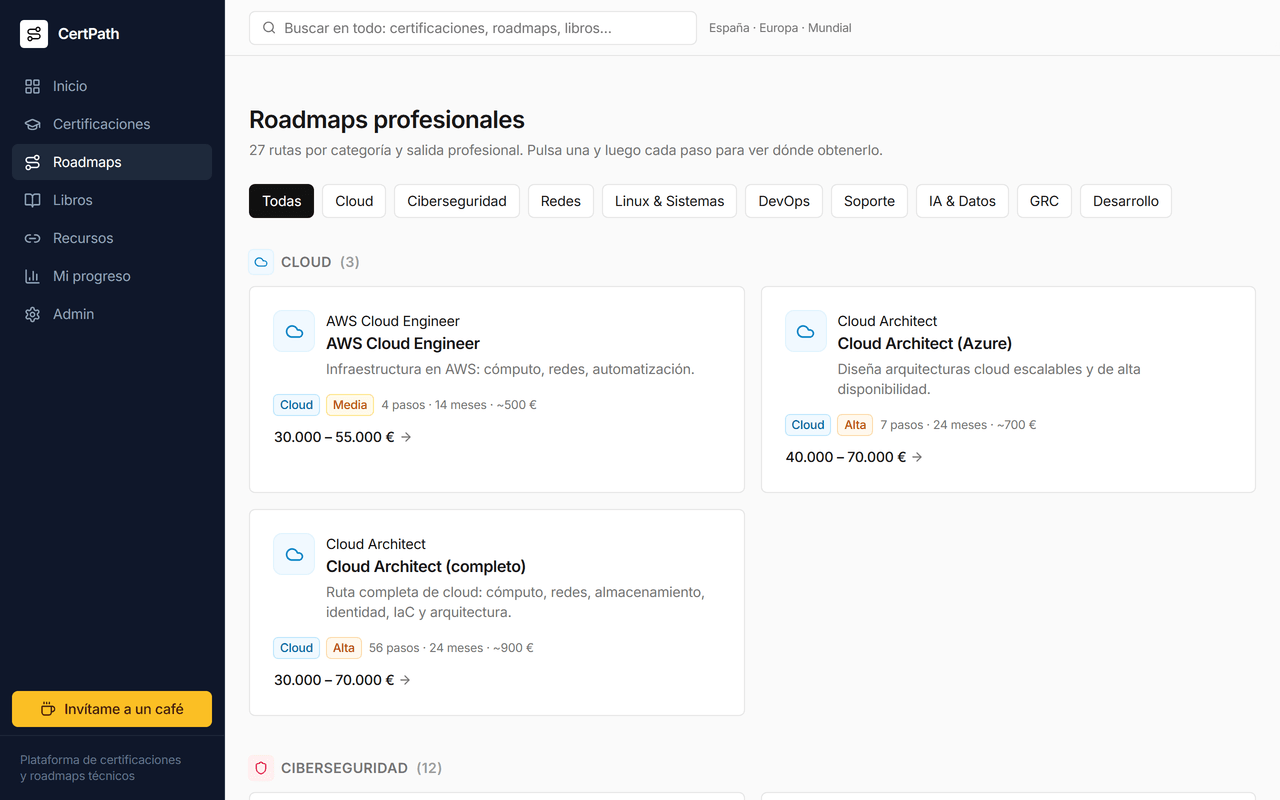
Roadmaps by role (systems administrator, network engineer, security analyst, cloud engineer…) work because they start with what you really want to be, not with a manufacturer's catalog. First, you define the destination; then, the path orders itself. CertPath is built around this idea.
The large families of certifications (and where each one fits)
To understand why a map is needed, it helps to see the terrain. These are, in broad strokes, the families that anyone who considers getting certified in IT will encounter:
- Microsoft / Azure. Very present in the business world. They are usually structured into three levels: foundations (to understand the ecosystem), associate (real technical role: administering, developing, securing) and expert. They fit well for system, cloud, and corporate administration profiles.
- AWS. The reference in public cloud. With its own ladder—foundations, associate, professional, and specialties—it's almost mandatory for those who want to focus on architecture or cloud engineering.
- Google Cloud. Growing, strong in data and cloud infrastructure. Interesting for profiles that combine cloud and analytics.
- Cisco. The historical standard in networking. Its path (from foundations to professional and expert levels) is almost a career in itself for those who want to specialize in networking.
- CompTIA. Neutral with respect to the manufacturer and very good as an entry point: it covers IT fundamentals, networking, and security without tying you to a specific brand. It's one of the most recommended for those who start from scratch.
- Cybersecurity. A world apart, with initiation certifications (defensive security, foundations) and others more advanced oriented towards auditing, management, or pentesting. Here, the order matters especially: jumping to advanced without a base is the perfect recipe for frustration.
- Red Hat and Linux. Essential for system profiles in Linux environments, with a very practical approach.
The key detail: these families do not exclude each other; they combine. A future cloud engineer can start with neutral foundations, continue with an associate certification from a provider, and finish with a specialty. Deciding on that combination, in the correct order, is exactly what CertPath helps you do.
What is CertPath exactly
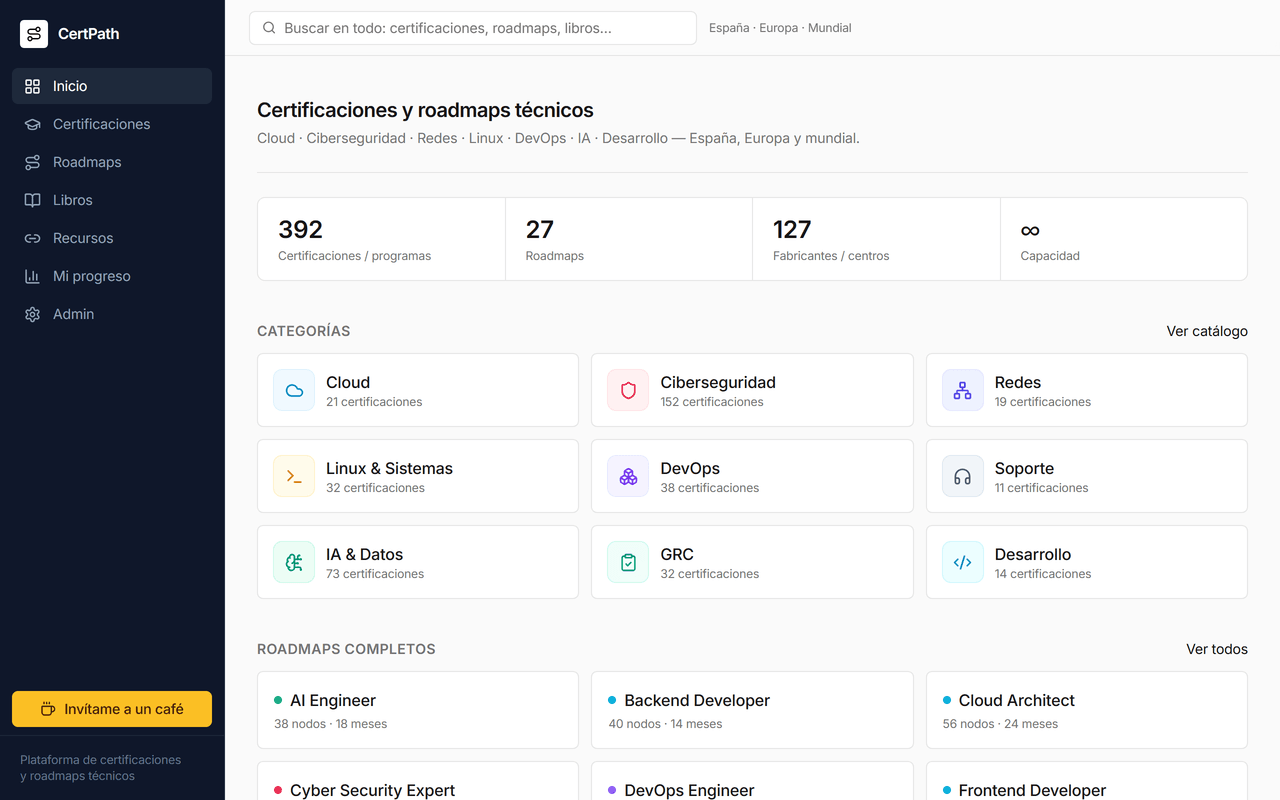
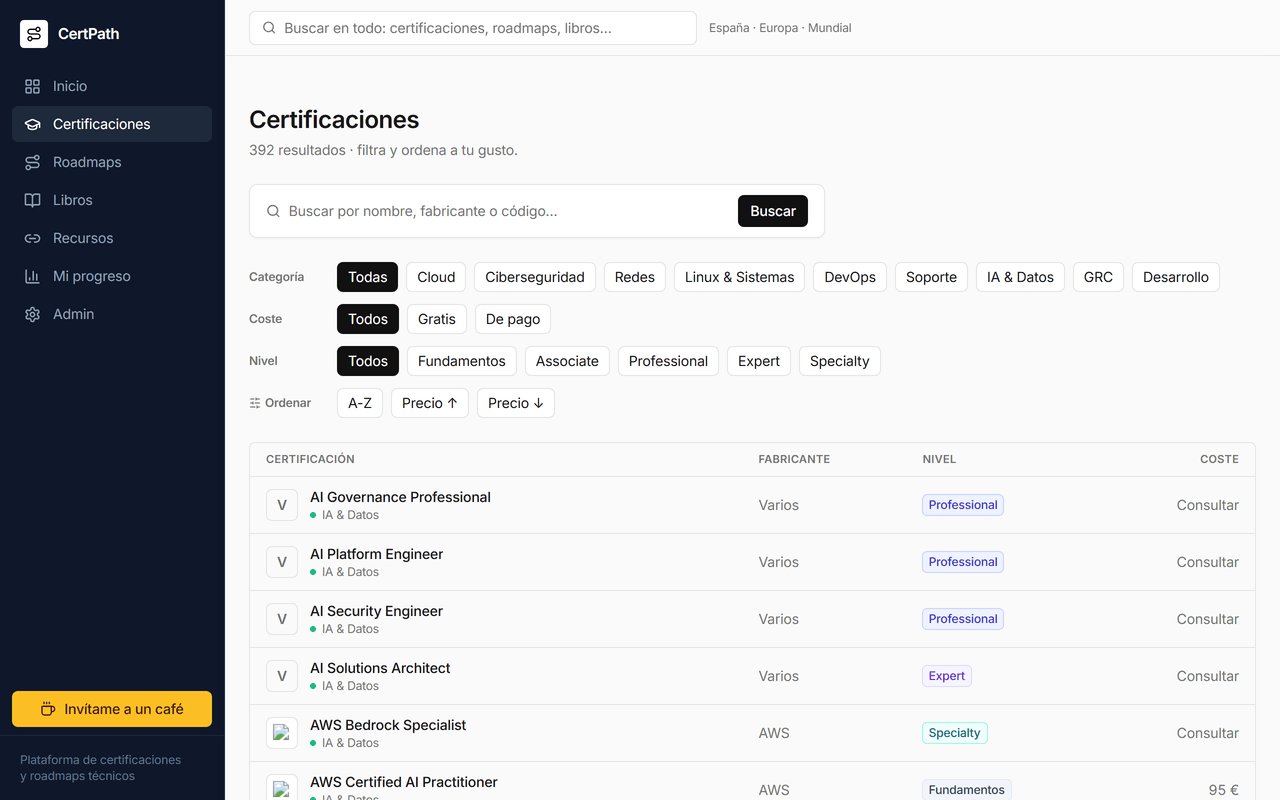
CertPath is a SaaS that helps technical profiles plan their career through guided certification paths, with progress tracking. In plain language: you choose where you want to go, and the platform shows you which certifications make sense to take, in what order, and lets you mark your progress.
The three ideas that support it are:
- Guided roadmaps by professional objective, not by flat list. It doesn't leave you with hundreds of certifications without context. It starts with the role or goal you're pursuing and organizes certifications into a route that makes sense, with dependencies between them (what makes sense before and what after).
- Progress tracking per user. Each person has their panel where they mark what they're completing, so progress isn't lost: it's saved and can be picked up whenever you want.
- A tool designed to be used for real, not a static infographic. It's an application with a user account, data persistence, and deployment in production.
The key is that CertPath doesn't try to teach you the syllabus of each certification—that's what courses and official documentation are for—but rather solves the previous problem, the one that almost no one solves: the decision. What, in what order, and why.
Screenshots
How it works internally
Here I get a bit more technical, because CertPath isn't just a landing page with a PDF behind it: it's an application with an architecture designed to grow.
Frontend in Next.js. The interface—the navigation through roadmaps, the progress panel, the views of each certification—is built with Next.js, which gives me fast rendering, good SEO, and a fluid application experience. It's what you see when you enter: the routes, the certification cards, the progress tracking.
Decoupled backend in NestJS. The business logic lives in a separate backend made with NestJS. This is a deliberate architectural decision: instead of putting everything in a single block, the server that manages the data, the relationships between certifications, and each user's progress is separated from the frontend. Why does it matter? Because it allows each part to evolve on its own, the backend can serve other clients in the future (a mobile app, for example), and the system is easier to maintain and reason about.
Persistence in PostgreSQL. The data—certifications, roadmaps, dependencies between them, and each user's progress—are stored in a PostgreSQL database. The fact that progress persists isn't a minor detail: it's what turns CertPath into a tool that accompanies you over time and not a one-time consultation.
Deployed in production. It's not an experiment on my laptop. The client-server architecture is deployed and working, with its frontend and backend running. You can enter and try it.
That separation—Next.js upfront, NestJS in the back, PostgreSQL as memory—is the backbone. It sounds like over-engineering for a personal project, and that's exactly why I did it this way: I wanted to demonstrate (to myself and to anyone who sees it) that I know how to set up a platform with product criteria, not just a prototype.
How to get the most out of it, step by step
Although CertPath is designed to be intuitive, here's how I recommend using it:
- Define your objective before looking at certifications. Don't start with "which exam do I take," start with "what do I want to be in one or two years." The destination orders the path.
- Choose the roadmap for the role you're pursuing. Let the route show you the logical sequence instead of jumping to the most popular certification.
- Be honest about your starting point. If you're starting from scratch, respect the foundations; if you already have experience, don't waste time on what you already master.
- Mark your progress for real. Actually registering what you've completed isn't decoration: it keeps motivation and gives you a realistic picture of how much you have left.
- Review the plan every so often. Catalogs change, and so do your objectives. A roadmap is a living map, not a stone.
Common mistakes when planning your certifications
These are the pitfalls that CertPath helps avoid, and that I see time and time again:
- Starting with the advanced. Launching into an expert certification without a foundation is the fastest way to burn out and give up.
- Collecting badges without direction. Getting certifications just because they "sound good" doesn't build a coherent profile; it scatters it.
- Copying someone else's path. What worked for a colleague may not fit your goal. The plan has to start from your destination, not theirs.
- Ignoring the opportunity cost. Each certification is weeks of your life. Choosing poorly isn't free.
- Not measuring progress. Without tracking, it's easy to lose the notion of progress and give up just when you were close.
Real use cases
CertPath makes sense in several moments of a technical career:
- The one who starts from scratch. Has just finished studying or is reorienting towards technology and has no idea where to start. CertPath gives them a clear starting point according to the role that attracts them.
- The one who wants to change specialties. Has been in systems for years and wants to move into cybersecurity or cloud. The roadmap for the new role shows them what they're missing and in what order it makes sense to get it.
- The one who is already in the field but is going blind. Has experience but has certified in a disorganized way, taking whatever came along without a plan. Seeing their path drawn helps them prioritize the next step with a clear head.
- The one who is preparing for a promotion or a job change. Knows what position they want and needs to align their certifications with what that position requires. The objective marks the route.
In all these cases, the value is the same: turning a distressing decision into an ordered plan.
Who it's for
CertPath is designed for technical profiles who take their career seriously: students of vocational training and university who want to enter well-oriented, IT professionals who seek to take a leap, and people who are reinventing themselves towards the technology sector from another field. It's also useful for those who guide others—tutors, mentors, team leaders—who need a clear way to show growth paths.
It's not for those seeking a shortcut to "pass without studying": CertPath doesn't give away knowledge; it organizes the path to acquire it.
What it offers compared to searching on your own
You could do all this by hand: open twenty tabs, read through each manufacturer's website, cross forums, note down in an Excel what comes before and what after. Many people do. The problem is that it's slow, prone to errors, and demotivating, and the Excel sheet becomes outdated as soon as the manufacturer changes its catalog.
CertPath saves you that blind research phase and gives you, from the start, a reasoned route with progress saved. The difference between starting with a map and starting with a box of loose pieces.
Current status and where it's headed
CertPath is in production: the client-server architecture is deployed, and you can try it out live. From that base, the natural growth directions are to expand the coverage of roadmaps and certifications, refine the dependencies between them as manufacturers update their catalogs, and enrich the progress panel. The decoupled architecture is designed precisely so that adding all this doesn't require redoing what's already been done.
Frequently asked questions
Does CertPath teach the syllabus of certifications? No. It focuses on the decision and planning: what to take, in what order, and why. For the syllabus, there are courses and official documentation from each manufacturer.
Is it useful if I already have experience? Yes. It helps you order what you're missing to reach a specific role without repeating what you already master.
Is it limited to a manufacturer? No. The idea is to reason by professional objective, combining families (neutral, cloud, networking, security) according to your goal.
In summary
CertPath solves a problem that almost everyone in technology suffers from and almost no one attacks head-on: deciding which certifications to take and in what order, based on where you want to go. It does this with guided roadmaps by objective, progress tracking, and a serious architecture (Next.js, NestJS, PostgreSQL) deployed in production.
If you're curious, you can see the full CertPath profile and try the demo. And if what you want is something similar for your own business—a custom platform, well-built and designed to last—let's talk: it's exactly the kind of project I enjoy building.